
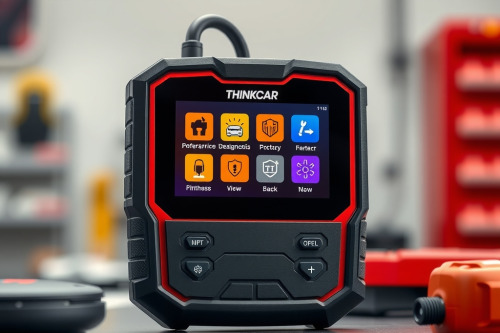
After spending twenty years busting knuckles in a busy shop, I have plugged hundreds of scan tools into stubborn OBD ports. The THINKTOOL Pros claims to be the best obd2 scanner for heavy diagnostic work, so I put it through hell on my rolling cart. From bi-directional controls to deep CAN-bus topology mapping, this unit promises dealership-level power without the absurd monthly subscription fees. Here is my raw, unfiltered breakdown on whether this tool earns a permanent spot in your bay.

Unboxing the THINKTOOL Pros in a working shop
When you unbox this tool on a greasy workbench, the first thing you notice is the heavy rubber armor. The outer housing feels rugged enough to survive an accidental drop off a lift arm onto hard concrete.
The tactile feel of the buttons is solid, and the rear kickstand locks firmly into place on your rolling cart. Stash the Bluetooth VCI dongle safely inside the built-in storage slot so it doesn't end up left inside a customer vehicle.
Connecting that VCI dongle under a dark, cramped dash is smooth thanks to the integrated LED indicator light. Screen visibility under direct sunlight is surprisingly clean, allowing you to read live data streams without squinting while standing outside near an open hood.
Why it stands out as the best obd2 scanner for hardware
A scan tool is useless if it spends three minutes booting up while customer cars pile up in your driveway. The quad-core processor inside this unit boots quickly and transitions between system menus with almost zero lag.
Battery life holds up remarkably well during continuous bay time throughout a ten-hour shift. Charging is handled via standard USB-C, which means you can top it off right on your workstation without proprietary power cords getting tangled around your creeper.
The touch interface responds reliably even when you're wearing thin nitrile gloves covered in synthetic oil. Having responsive hardware keeps you focused on fixing cars instead of fighting your diagnostic equipment.
Bi-directional controls and deep module coding
Having simple code reading capability is fine for oil changers, but real diagnostic work requires active testing. The bi-directional control menu lets you pulse fuel injectors, actuate cooling fans, and command EVAP purge valves with zero hesitation.
Module initialization and injector coding features rival what expensive OEM scan tools offer at three times the cost. You can perform throttle body recalibrations and steering angle sensor resets right after finishing front-end alignment work.
The live data graph viewer lets you overlay up to four sensor PID readings simultaneously. Watching oxygen sensor response times alongside short-term fuel trim values makes locating vacuum leaks instant work.
Real shop testing and handling diagnostic rabbit holes
Just last Tuesday, I had a stubborn Ford F-150 in my bay with an intermittent misfire on cylinder four. Standard fault codes pointed toward a bad coil pack, but swapping coils didn't clear the issue.
I hooked up the THINKTOOL Pros and pulled up the smart network topology map. The diagnostic visual instantly highlighted an intermittent communication failure along the high-speed CAN-bus lines feeding the powertrain control module.
Analyzing the freeze frame data prevented me from going down a costly diagnostic rabbit hole and throwing unneeded parts at the truck. Inspecting the harness revealed a chafed wire rubbing against the firewall, saving the customer money and preventing comebacks.
To keep things completely honest, the unit isn't totally flawless. Software updates over Wi-Fi can be painfully slow during peak shop hours, and full system auto-scans on pre-2005 GM vehicles can take noticeably longer than on newer European models.
Comparing real-world performance to find the best obd2 scanner
For a flat-rate tech trying to earn a living, tool investment versus daily returns is everything. High-end truck units from Snap-on or Autel cost a fortune and charge massive fees every time you update software.
This tool delivers roughly ninety percent of high-tier OEM functions for a fraction of the upfront cost. The inclusion of software coverage for over one hundred vehicle brands makes it a workhorse for independent repair shops.
You get advanced ECU coding capabilities without needing a separate laptop setup for basic pass-thru flash jobs. That efficiency keeps vehicles moving out of your bays faster every single day.
Final verdict on preventing comebacks
If you need a rugged, dependable diagnostic platform that delivers deep module access without bankrupting your shop, this is easily the best obd2 scanner to boost your daily throughput. It pinpoints electrical gremlins quickly and helps eliminate customer comebacks before vehicles leave your shop floor.
Take a hard look at your current diagnostic lineup today. Grab a unit to test on your own shop floor, inspect your shop workflow, or leave a comment below sharing what diagnostic gear keeps your bays running at peak performance!