
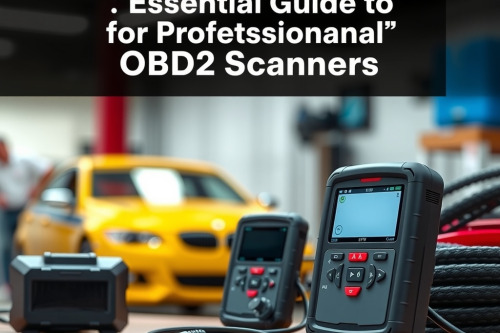
After spending 22 years busting knuckles in a busy shop, I know that chasing electrical ghosts without a dependable Professional OBD2 Scanner will ruin your flat-rate day. Hooking up a top-tier tool gives you instant visibility into live PID data, bi-directional controls, and hidden OEM trouble codes. Whether you're clearing false lamp triggers or diagnosing complex CAN-bus dropouts on a rolling cart, the right unit saves billable bay time. Here's my breakdown on selecting and using high-level diagnostic gear to stop comebacks cold.

Selecting a Professional OBD2 Scanner for real shop work
When you're working on a lift all day, you can't waste time with cheap code readers that only pull basic global OBD2 data. You need a dedicated unit that communicates across proprietary networks like Ford MS-CAN or GM GMLAN. A solid tool gives you access to full system scans, body control modules, transmission lines, and anti-lock brake systems.
I look for hardware that feels sturdy in the hand with rubberized corner bumpers to survive grease and concrete drops. The display must be bright enough to read under direct sunlight when you're testing outdoors or under shop lighting. Wireless VCI dongles are great, but the Bluetooth connection must remain stable when you walk around the vehicle.
Processing speed and topology mapping
Modern architecture demands fast processing units. A high-end tool displays full system topology maps, allowing you to see every control module on the network color-coded by status. This visual overview saves crucial minutes during initial triage.
Important features every technician needs on the rolling cart
Bi-directional control is the single most important feature for a flat-rate tech. If you cannot command a fuel pump relay on, pulse an injector, or cycle an ABS solenoid, you're just guessing. Active testing isolates mechanical failures from wiring harness issues instantly.
Live graphing capabilities are equally vital. Watching a single numeric parameter flicker on a screen makes it easy to miss rapid dropouts. Overlaying multiple PIDs like mass air flow, throttle position, and oxygen sensor voltage on one graph highlights timing discrepancies clearly.
Freeze frame and graphing features
Freeze frame data captures the exact engine load, coolant temperature, and fuel trim values the exact millisecond a DTC sets. Analyzing short term and long term fuel trims under captured fault conditions prevents you from throwing parts at a car blindly.
Troubleshooting real-world vehicle issues in the bay
Just last Tuesday, I had a stubborn Ford F-150 in my bay with an intermittent misfire under heavy acceleration. The customer had already replaced spark plugs and ignition coils without success. The ECU had stored a generic P0300 code, but no specific cylinder fault was locked in memory.
I grabbed my best obd2 scanner, hooked up the wireless VCI under the heavy dash, and pulled up the mode 06 misfire counts. The live data immediately pointed to cylinder four exceeding its failure threshold during high torque load. A quick bi-directional balance test confirmed a weak fuel injector driver circuit rather than a mechanical fault.
Resolving CAN-bus network disruptions
Intermittent module communication errors can freeze an entire shop floor. Using advanced scope functions on your scanner allows you to verify physical bus voltages and locate terminating resistor breakdown without pulling trim panels unnecessarily.
Avoiding common traps with a Professional OBD2 Scanner
Even the highest quality scanner is only as good as the technician operating it. A common pitfall is clearing codes before reviewing freeze frame data or checking monitor readiness flags. Once those frames are wiped, you lose the precise operating parameters captured when the fault occurred.
Software update subscriptions can also catch shop owners off guard. Some manufacturers lock out key bi-directional functions or functional resets if your annual software patch expires. Always check the brand updates policy so your rolling cart stays fully functional.
Understanding scanner software coverage limits
No single tool covers every vehicle platform perfectly. European imports often require specific coding functions that generic software packages fail to perform. Keeping a secondary scanner or OEM passthrough device ready prevents workflow bottlenecks.
Maximizing shop productivity and eliminating comebacks
Preventing comebacks requires proving your repair before the customer leaves the lot. After replacing components, perform a full drive cycle and re-check readiness monitors with your tool. Running automated health reports creates a professional paper trail for your shop records.
Using a fast scanner drastically cuts diagnostic time per vehicle, allowing you to turn more tickets per shift. Time saved on initial scans translates directly into higher productivity and better pay checks for flat-rate technicians.
Building customer confidence with diagnostic printouts
Printing or emailing before-and-after system scan reports shows vehicle owners tangible proof of trouble codes and successful fixes. Transparency builds long-term customer trust and keeps your service bays full year round.
Final shop verdict on diagnostic tools
Investing in a high-grade Professional OBD2 Scanner is an absolute requirement for any technician serious about modern auto repair. Having fast processing, deep OEM coverage, and dependable bi-directional testing right on your rolling cart prevents diagnostic rabbit holes and keeps billable hours high. Inspect your current tool setup today, upgrade to a capable unit, and eliminate guesswork in your shop for good.