
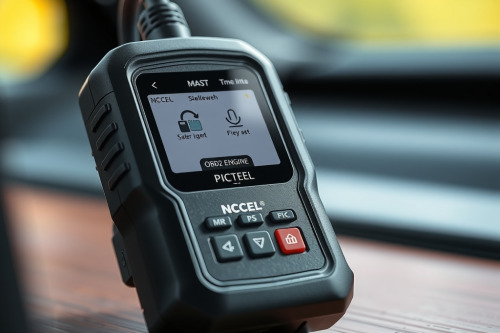
After twenty years of busting knuckles in a busy shop, I've plugged hundreds of scan tools into stubborn OBD2 ports under cramped dashboards. When a basic reader lands on my rolling cart, I put it through hell to see if it naturally saves bay time or just sits in the drawer. This Ancel AD310 review comes straight from my shop floor after pulling real trouble codes on everything from rusted Ford trucks to fussy Hondas. If you want a simple tool that reads fault codes without frozen screens or endless menu delays, this unit deserves a spot on your toolbox.

Unboxing and real-world durability for shop use
Taking this reader out of the box, you notice the thick rubberized housing right away. It doesn't feel like cheap brittle plastic that cracks the second a flat-rate tech drops it onto concrete floor.
The hardwired cable is thick enough to survive being dragged across hot exhaust manifolds, and the 16-pin connector snaps firmly into place under dusty dashboards without feeling loose. The tactile feel of the rubber buttons gives decent feedback even when your fingers are slick with oil or 80W-90 gear lube.
The monochrome backlit display is bright and clear under direct sunlight. You don't have to squint or shade the screen with your hand when working on a car parked outside in the afternoon heat.
How the Ancel AD310 review holds up on the diagnostic line
Just last Tuesday, I had a stubborn Ford F-150 in my bay with an intermittent misfire and an illuminated check engine light. The customer claimed another shop replaced all the spark plugs, but the truck still stumbled violently under heavy load.
I grabbed this code reader from my cart and hooked it to the vehicle. Within three seconds, the unit powered up off the car battery and pulled a stored P0301 code alongside pending P0171 lean codes on bank one.
Instead of sending me down a diagnostic rabbit hole chasing phantom electrical gremlins, the quick code read let me jump straight to testing the coil pack on cylinder one. I pulled the boot and found carbon tracking immediately. That speed saved me twenty minutes of setup compared to booting up my heavy flagship diagnostic console.
Reading freeze frame data and live sensor streams
A basic reader that only gives code numbers is almost useless when preventing comebacks. You need to know what the engine was doing the exact millisecond the fault code tripped.
This handheld unit pulls freeze frame data instantly, showing engine coolant temperature, calculated load, speed, and short-term fuel trim values. When diagnosing vacuum leaks, seeing fuel trims jump past plus twenty percent at idle confirms unmetered air entering through a torn intake boot or bad intake gasket.
It also graphs live sensor data streams for basic parameters like engine RPM, manifold absolute pressure, and oxygen sensor voltages across standard CAN-bus architecture. While the screen update rate is not as rapid as a high-end scope, it is quick enough to spot a dead MAF sensor or stuck closed thermostat.
Where this code reader hits its diagnostic limits
I stay honest with my guys about what every tool can and can't do on the floor. This unit is built specifically for generic powertrain OBD2 diagnostics, meaning engine and transmission trouble codes on light-duty passenger vehicles.
Don't expect this device to talk to proprietary body control modules, reset steering angle sensors, perform ABS brake bleeding, or retract electronic parking brake calipers. If a customer brings in a BMW with an airbag warning or a late-model Chevy with a traction control light, this tool won't pull those manufacturer-specific codes.
Software updates are virtually non-existent because the unit operates on fixed firmware protocols. For complex bi-directional testing or module coding, you still need to wheel out your heavy professional diagnostic platform.
Comparing entry-level scanners against professional scan tools
Every technician knows that expensive professional scanners costing thousands are important for advanced troubleshooting, but using them for quick initial scans wastes valuable shop time. Keeping an agile best obd2 scanner on your hip keeps you moving from bay to bay without waiting for operating systems to boot up.
For quick pre-scans during routine maintenance or test drives, a compact reader delivers immediate results. It lets you clear nuisance codes after replacing a loose gas cap without cluttering your main diagnostic station.
It also gives clear readiness monitor status icons so you can tell a customer instantly whether their vehicle will pass state emissions testing after clearing memory codes.
Final verdict on our Ancel AD310 review and shop recommendation
If you need a dependable, rugged entry-level code reader that gets straight to the point without fuss, this unit pays for itself within its first week of service. Our detailed Ancel AD310 review confirms it's a tough, fast-operating tool that every flat-rate tech, mobile mechanic, or serious car owner should keep in their tool chest.
Grab your own unit today, keep it in your service truck or glovebox, and stop wasting valuable bay time on simple check engine light calls.