
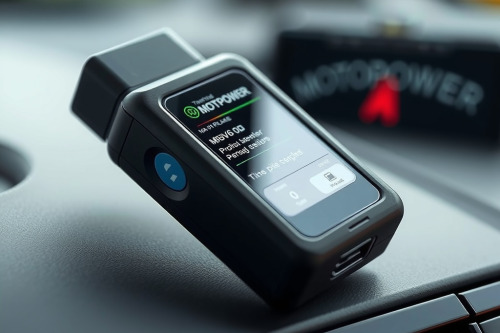
After twenty-five years of busting knuckles in a busy diagnostic shop, I know that keeping a quick handheld reader around saves precious bay time when a car rolls in with a lit check engine light. The Motopower MP69033 OBD2 Code Reader gives you fast access to basic diagnostic trouble codes and engine freeze frame data without dragging out a thousand-dollar scan tool. While it won't perform bi-directional tests or reflash modules, this compact unit serves as a dependable frontline tool for fast triage on the shop floor.

Unboxing the Motopower MP69033 OBD2 Code Reader on the bench
When you pull this scanner out of the box, the first thing you notice is the thick rubberized housing. It feels sturdy in your palm, designed to survive an accidental drop onto concrete from a rolling cart. The built-in heavy OBD2 cable length gives you enough slack to stand comfortably beside the driver door while plugging into the data link connector under the dash.
The screen is a clear back-lit monochrome LCD with crisp resolution. You can easily read error codes and parameter definitions under direct sunlight or harsh shop bay fluorescent lighting. The membrane buttons offer a solid tactile click that responds well even when you are wearing greasy nitrile gloves.
How the Motopower MP69033 OBD2 Code Reader handles live data
Connecting to standard protocol networks takes only a few seconds. The unit powers up directly off the 12-volt battery power supplied through pin sixteen of the vehicle DLC, so you never have to worry about dead internal batteries mid-test. Once initialized, it quickly polls engine management computers using standard ISO 9141, KWP2000, J1850, and CAN-bus protocols.
Live data streaming on this reader allows you to monitor primary sensor inputs in real time. You can monitor short term fuel trims, long term fuel trims, calculated engine load, engine coolant temperature, and intake manifold absolute pressure. Watching short term fuel trims instantly jump positive while spraying brake cleaner around a leaking intake gasket saved me hours of diagnostic rabbit hole chasing last week.
Real shop diagnostic test on an intermittent misfire
Just last Tuesday, a customer pulled into my bay driving a 2012 Ford F-150 with a severe shudder under load and a flashing MIL. Rather than wheeling out my high-end diagnostic station, I grabbed this simple reader from my top toolbox drawer. Within twenty seconds, the screen displayed generic code P0304 along with freeze frame telemetry recorded at the moment the fault triggered.
The freeze frame snapshot revealed engine speed at 2,100 rpm under an eighty percent calculated load with coolant temperature at 195 degrees Fahrenheit. That specific data confirmed the misfire occurred under heavy load rather than at idle. Swapping the cylinder four ignition coil with cylinder one proved the coil was failing under stress, turning a potentially complex diagnostic headache into a fifteen-minute turn-around repair that prevented a costly comeback.
Key limitations every flat-rate tech should expect
No budget tool comes without practical compromises. This device reads generic powertrain codes starting with P0, P2, and P3, but it can't access specialized OEM manufacturer-specific body control modules, anti-lock brake systems, or supplemental restraint system airbags. If you need to calibrate a steering angle sensor or bleed an ABS hydraulic unit, this pocket scanner will leave you stranded.
The software firmware update process also relies on a mini-USB connection to a Windows PC, which can occasionally drop handshake communication on older operating systems. European import vehicles with non-standard OBD2 implementations occasionally trigger connection error messages until you cycle the ignition key.
Comparing pocket readers against full diagnostic platforms
Every technician needs to understand where a basic reader fits into daily shop workflow. A full-featured diagnostic scanner costs thousands of dollars and requires annual software subscriptions, but it grants bi-directional control over actuators like fuel pumps and EVAP purge valves. On the other hand, handheld code readers cost a fraction of that and require zero recurring subscription fees.
For routine maintenance check-ins, oil change resets, and initial intake triage, carrying a simple code reader in your pocket saves energy and time. It lets you clear nuisance codes after replacing an oxygen sensor or gas cap without tying up major bay equipment.
Final verdict on the Motopower MP69033 OBD2 Code Reader
If you need a rugged, simple scanner for quick code clearing and basic sensor monitoring, the Motopower MP69033 OBD2 Code Reader earns its spot on your toolbox lid. It provides clear parameter definitions, rapid connection speeds across major CAN-bus platforms, and honest freeze frame data without bloated menus or hidden costs.
Inspect your shop workflow and pick up one of these units to speed up your initial vehicle intake today. Having an accurate handheld device ready at a moment's notice will keep your bays moving and boost your daily flat-rate efficiency.