
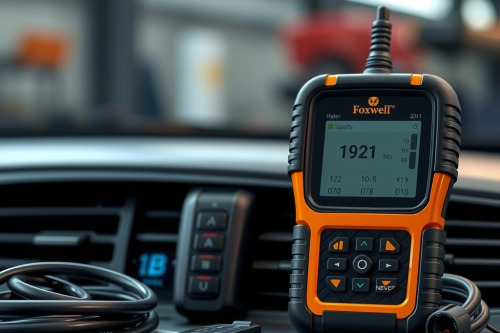
After twenty years of busting knuckles on everything from fleet trucks to daily drivers, I know that a dependable OBD2 Scanner is the true backbone of quick shop diagnostics. In this detailed FOXWELL NT301 review, I'll break down how this compact unit pulls freeze frame data, reads live PID streams, and clears check engine lights without wasting your valuable bay time. You don't need a multi-thousand-dollar scan tool just to verify readiness monitors or trace an intermittent misfire. We tested this handheld unit under greasy shop conditions so you can decide if it belongs on your rolling cart.

Why this FOXWELL NT301 review matters for working techs
As a flat-rate tech, every minute spent fighting sluggish software or rebooting a frozen diagnostic tablet eats straight into your earnings. You need a fast tool that powers up through the vehicle data link connector the exact second you plug it into the OBD port. The FOXWELL NT301 review process proved to me that basic code readers still have a vital place in modern repair shops. It bypasses complex boot sequences so you can check DTC codes, look at pending faults, and verify readiness monitors instantly.
When a customer drops off a car with a glowing check engine light, grabbing a giant diagnostic console for a two-minute preliminary scan is overkill. This handheld scanner lets you quickly triage incoming vehicles before sending them deeper into the bay. It keeps you from falling down an unnecessary diagnostic rabbit hole on simple oxygen sensor or gas cap issues.
Unboxing the FOXWELL NT301 review unit and hardware build
Holding the unit in your hand, you immediately notice the rugged rubberized casing designed to survive drops onto shop concrete. The clicky rubber buttons give positive tactile feedback even when wearing heavy nitrile gloves coated in oil. The 2.8-inch TFT color screen stays crisp and legible even under direct sunlight near open shop doors.
The integrated OBD2 cable feels thick and flexible, resisting kink damage when snaked under a crowded dash. Unlike wireless setups with separate VCI dongles that techs frequently leave plugged into customer dashboards, this hardwired connection never drops pairing midway through reading data. The unit draws power straight from pin sixteen of the OBD port, so you never worry about dead internal batteries during field work.
Live data graphing and freeze frame capabilities
Code readers are only as good as the live data they provide, and this device delivers solid performance across standard parameters. You can display live PID streams for engine coolant temperature, calculated load, short-term fuel trim, and long-term fuel trim in both text and real-time graph modes. Merging two PID graphs on one screen allows you to compare upstream and downstream oxygen sensor switching in real time.
Freeze frame data capture is another crucial feature for preventing comebacks. When the engine control module triggers a code, it takes a snapshot of operating conditions such as engine RPM and vehicle speed at that exact millisecond. Reviewing freeze frame data helps you recreate the precise driving conditions under which a fault occurred.
Real shop scenario and hands-on diagnostic experience
Just last Tuesday, I had a stubborn Ford F-150 in my bay with an intermittent misfire under load. The customer complained that the truck stumbled during highway acceleration, but no hard active code was stored. I hooked up the FOXWELL NT301 scanner to pull mode six test data and check pending diagnostic trouble codes. Within minutes, the live PID monitoring showed long-term fuel trim spiking positive on bank one while accelerating, pointing directly to a dirty mass air flow sensor rather than an ignition coil failure. Fixing the sensor saved two hours of guesswork and kept my bay moving efficiently.
Where the scanner shines and where it falls short
For standard OBD2 protocols including CAN, J1850 PWM, J1850 VPW, ISO9141, and KWP2000, this tool operates flawlessly. The dedicated one-click I/M readiness important is a massive time-saver for state emission inspections, showing red, yellow, and green LED indicators instantly. It reads clear generic codes like P0300 alongside OEM specific codes across domestic, Asian, and European passenger vehicles.
However, honesty demands highlighting its natural limits. This unit cannot access non-OBD2 systems such as ABS, airbag modules, transmission control units, or body control modules. It also lacks bi-directional controls, meaning you can't command component tests like purging an EVAP solenoid or cycling a fuel pump relay. Software updates require connecting to a Windows PC via USB cable, which can feel clunky if you rely solely on modern tablets.
Final verdict: summary of our FOXWELL NT301 review
If you need a rugged, fast, and dependable code reader that delivers accurate live PID data without financial bloat, this device delivers high value. Finishing our FOXWELL NT301 review, I recommend keeping this unit right on your primary rolling cart for quick check-ins, road tests, and emission readiness checks. Inspect your diagnostic tool inventory today, order a dedicated corded scanner for your shop bay, and keep your diagnostic workflow moving fast.