
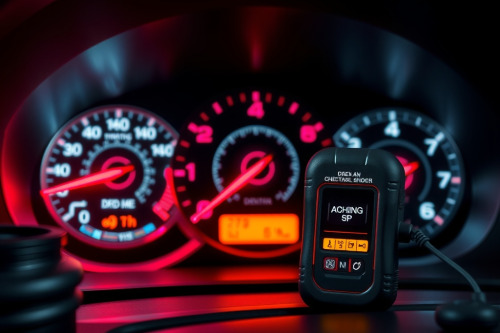
After spending twenty years busting knuckles in an independent auto repair shop, I know how fast a glowing yellow dashboard icon can turn a smooth workday into a diagnostic nightmare. Finding the right OBD2 Scanner for Check Engine Light troubleshooting is the single best way to pinpoint faulty oxygen sensors, evaporative emissions leaks, and cylinder misfires before wasting money on unnecessary parts. We depend on these tools to pull freeze frame data and live sensor graphs to keep bay time short and comebacks nonexistent. This breakdown covers what matters when picking a scan tool that works under real shop conditions.

Why every shop needs a dependable OBD2 Scanner for Check Engine Light work
When a car rolls into my bay with an illuminated MIL, guessing never works. A code reader that only throws out generic P0300 codes without context sends a flat-rate tech straight down a diagnostic rabbit hole. You need hardware that connects instantly to the CAN-bus network and decodes OEM-specific fault codes accurately.
Cheap dongles often drop bluetooth connection right as you clear codes or execute an active test. A professional unit needs a rugged rubberized housing, tactile rubber buttons that respond through greasy gloves, and a display screen that remains perfectly legible under bright sunlight. Cutting corners on your main scanner wastes billable hours and hurts customer trust.
Essential features that separate professional scanners from toy code readers
A basic reader displays DTCs, but a true diagnostic tool gives you bidirectional control and live parameter graphing. If you can't command a purge solenoid to open or monitor fuel trim values in real time, you're working blind. Short-term and long-term fuel trim numbers tell you whether an engine is fighting a vacuum leak or a failing fuel injector.
Freeze frame data is another feature you can't live without in a busy shop. When an intermittent stumble occurs under heavy load at highway speeds, the freeze frame snapshot captures engine RPM, coolant temperature, vehicle speed, and calculated load at the exact millisecond the fault triggered. Having those parameters saved on your rolling cart prevents hours of unproductive test driving.
Real world diagnostic scenario: tackling a stubborn misfire
Just last Tuesday, I had a stubborn Ford F-150 in my bay with an intermittent misfire that another local shop failed to solve. The owner had already replaced all eight spark plugs and two ignition coils based on a simple code scan. My scan tool hooked up under the heavy dash, pulled freeze frame data, and revealed a secondary condition tied to a bank two lean condition.
By graphing short-term fuel trims alongside O2 sensor voltage while tapping around the intake manifold with brake cleaner, I spotted a tiny vacuum leak near the PCV elbow. What looked like an expensive ignition fault turned out to be a twelve-dollar rubber hose. Having live graphing and fast data refresh rates saved the customer hundreds of dollars and proved the value of thorough diagnostics.
Understanding live sensor data and diagnostic trouble codes
Understanding what your scanner displays is just as crucial as having the hardware itself. A code like P0171 indicates a system too lean on bank one, but it never tells you which component failed. It could be a dirty MAF sensor, low fuel pump pressure, or a torn intake boot.
Connecting your scanner to view live sensor PID streams allows you to isolate the root cause methodically. If the mass air flow reading stays flat when snapping the throttle, you know the sensor is contaminated or failing internally. Graphing multiple parameters simultaneously shows physical relationships between engine air intake, fuel delivery, and spark timing.
Common pitfalls when using an OBD2 Scanner for Check Engine Light codes
The biggest mistake young technicians make is swapping parts immediately based solely on a code description. Code definitions are starting points for an investigation, not shopping lists for the parts counter. Erasing codes before documenting freeze frame data wipes away vital diagnostic clues that you might never recreate.
Another issue comes from cheap software that fails to read proprietary manufacturer protocols like Ford MS-CAN or GM SW-CAN. If your tool can't access body control modules or transmission controllers, you miss critical context behind specific powertrain codes. Always make sure your diagnostic scanner receives regular firmware updates to stay compatible with newer vehicle architectures.
Final shop recommendations for picking your diagnostic tool
Selecting an OBD2 Scanner for Check Engine Light diagnosis comes down to speed, build durability, and software accuracy. Test the rubberized casing, check how snugly the OBD2 cable locks into the vehicle port, and make sure the screen stays bright under garage lighting. Buy a tool with reliable manufacturer support, intuitive navigation, and multi-graphing capabilities.
Inspect your current diagnostic setup today, replace fragile wireless dongles with heavy-duty scan tools, and elevate your shop productivity now.